

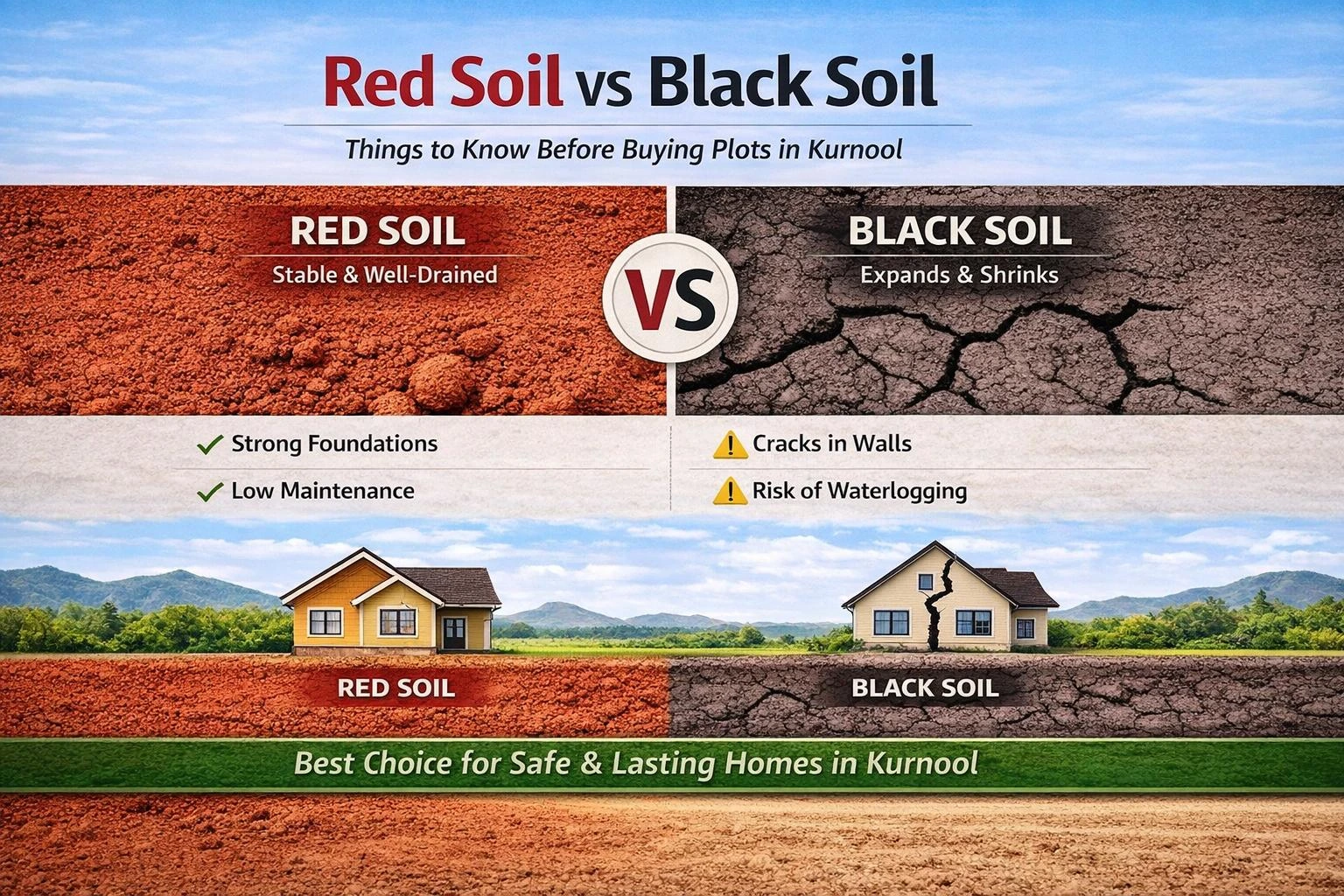
Buying a plot is not just about owning land—it is about securing a safe future for your home and family. While many buyers focus on location, price, and road access, the most critical factor often goes unnoticed: the soil beneath the land. Understanding the things to know about soil before buying plots helps buyers avoid costly construction mistakes and ensures long-term property value.
In Kurnool, soil type plays a major role in how a building performs over time. This guide explains soil varieties available in Kurnool, clarifies red soil vs black soil, and helps buyers understand which soil suits housing and which suits farming.
Soil Varieties Naturally Available in Kurnool
Kurnool has a mix of naturally occurring soil types due to its geography and climate. Red soil is widely found in elevated regions and residential zones. Black soil appears mainly in low-lying agricultural areas. Sandy and mixed soils exist near dry riverbeds, while many red soil areas are supported by strong rock layers beneath the surface.
Knowing the availability of these soil types helps buyers make informed decisions rather than relying only on surface appearance or price.
Choosing the Right Soil Before Buying a Plot
Choosing the right soil before buying a plot directly affects foundation strength, construction cost, and long-term safety. Soil determines how water drains, how the foundation settles, and how the structure behaves during seasonal changes. A plot with unsuitable soil can demand deeper footings, higher construction budgets, and ongoing maintenance.
Smart plot buyers always check this soil factor early, as soil quality cannot be easily corrected later.
Plot Reality: Red Soil vs Black Soil
One of the most common questions buyers ask is, “Before you buy a plot: red soil vs black soil?” While both soils exist naturally in Kurnool, they serve very different purposes.
When comparing red soil vs black soil, the difference becomes important once construction is involved. Red soil is naturally firm, drains water easily, and remains stable across seasons, which makes it well suited for residential houses and plotted developments. Black soil, while highly fertile and excellent for farming, retains a large amount of moisture and tends to expand during the rainy season and shrink during summer. This continuous movement can place stress on foundations, increase footing depth, and raise construction costs if not carefully engineered. For this reason, buyers planning to build homes generally prefer red soil, while black soil is more suitable for agricultural use rather than residential construction.
Black soil is highly fertile and excellent for farming because it retains moisture. However, for houses, this same property becomes a disadvantage. Black soil expands during monsoon and shrinks during summer, creating movement beneath foundations. Red soil, in contrast, drains water naturally and remains stable throughout the year.
This makes the red soil vs black soil comparison crucial for residential buyers.
Which Soil Is Better for Housing and Which Is Better for Farming?
When comparing soil suitability, purpose matters. Black soil is best suited for agriculture due to its moisture retention and nutrient richness. Red soil is better for housing because it offers consistent load-bearing capacity, minimal expansion, and strong foundation support.
For buyers planning homes or open plots, red soil vs black soil plots clearly favor red soil for safety, durability, and predictable construction outcomes.
Safe Land Soil Type for Residential Construction in Kurnool
Kurnool experiences intense summers and seasonal rainfall. In such conditions, soil stability becomes essential. Red soil handles these variations well by allowing excess water to drain while maintaining firmness. Black soil, unless engineered carefully, can increase construction risk.
One of the best examples of this thoughtful planning is Anantha Projects Filmnagar, a premium plotted development designed entirely on pure red soil, supported by strong natural rock layers found at shallow depth. The project is also positioned on naturally elevated land, which improves drainage and protects future constructions from water-related issues. Buyers who choose plots here benefit from soil stability, reduced foundation complexity, and long-term structural confidence.
This is why red soil is widely regarded as the safe land soil type for residential construction in Kurnool.
Construction Challenges on Black Soil Residential Plots
In several parts of Kurnool, residential plots have been developed on black soil due to land availability. While construction is possible, it often requires deeper foundations, special footing designs, and additional soil treatment. These measures increase construction costs and demand extra care during building.
Compared to this, red soil-based residential plots generally require simpler foundations and offer better long-term performance.
Why Red Soil with Rock Base Adds Long-Term Value
Beyond surface soil, what lies below is equally important. Plots where rich red soil exists above thick, strong rock layers—often found within about five feet below ground—provide excellent foundation strength. This natural combination reduces excavation risk, improves load-bearing capacity, and increases long-term structural safety.
Naturally, selecting such plots offers maximum long-term weightage and value, especially for buyers looking at appreciation and resale.
Why Red Soil Plots Are Preferred in Kurnool
Over time, buyers in Kurnool have become more aware of soil-related construction issues. Houses built on red soil show better durability and fewer structural concerns compared to those on black soil. This awareness has increased demand for red soil plots, especially in planned residential layouts.
As a result, red soil is now considered one of the best soil types for long-term property investment in the region.
Why Anantha Projects Layouts Are Built for Long-Term Safety and Value
Anantha Projects has followed a strict land selection philosophy across developments such as Anantha Filmnagar, Anantha Banjara Hills, and Anantha Dr’s Farm Lands. These layouts are naturally planned on rich red soil, with thick and strong rock layers typically found within around five feet below the surface.
One of the best examples of this thoughtful planning is Anantha Projects Filmnagar, a premium plotted development designed entirely on pure red soil, supported by strong natural rock layers found at shallow depth. The project is also positioned on naturally elevated land, which improves drainage and protects future constructions from water-related issues. Buyers who choose plots here benefit from soil stability, reduced foundation complexity, and long-term structural confidence.
This natural geological advantage supports safe construction, efficient drainage, and long-term durability. By choosing land with pure red soil and a strong rock base, these developments offer buyers higher confidence, better construction efficiency, and stronger future value compared to plots developed on loose or black soil.
Final Thought: Why Red Soil Is Best in Kurnool
In simple terms, red soil is best in Kurnool because it stays firm, drains water easily, and supports strong foundations year after year. Black soil may be excellent for farming, but for houses it often demands extra engineering and higher costs.
Understanding the things to know about soil before buying plots, especially the difference between red soil vs black soil, helps buyers make safe, informed, and future-ready decisions.
Frequently Asked Questions (FAQ)
What types of soil are naturally available in Kurnool?
Kurnool naturally has a mix of red soil, black soil, sandy soil, and rocky strata beneath the surface. Red soil is commonly found in elevated residential regions, while black soil is more prevalent in low-lying agricultural areas. Sandy soil appears near dry riverbeds, and in many red soil zones, strong rock layers are present below the ground, which supports construction stability.
Which soil is better for buying residential plots in Kurnool?
For residential plots, red soil is considered the safest option in Kurnool. It provides stable load-bearing capacity, drains water naturally, and does not expand or shrink excessively with seasons. These properties make red soil more suitable for houses compared to black soil, which often requires additional foundation care.
Is black soil good for building houses?
Black soil is generally not preferred for housing unless special engineering methods are used. It expands during the rainy season and shrinks during summer, which can create stress on foundations. While houses can be built on black soil, the construction cost is usually higher due to deeper footings and additional reinforcement.
Which soil is better for farming in Kurnool?
Black soil is better suited for farming because it retains moisture and nutrients for longer periods. This makes it ideal for agriculture. Red soil, while usable for certain crops, is more commonly preferred for residential and plotted developments rather than intensive farming.
Why does soil type affect construction cost?
Soil type directly influences foundation depth, footing design, and soil treatment requirements. Stable soils like red soil generally require simpler foundations, while black or loose soils often demand deeper excavation and additional reinforcement, increasing construction costs and timelines.
What role does the rock layer below the soil play in plot safety?
A strong rock layer beneath the soil significantly improves a plot’s load-bearing capacity. When red soil sits on top of thick rock layers found within a few feet below ground level, it creates a naturally strong base for construction. This reduces foundation risk and enhances long-term structural safety.
Why are red soil plots preferred for long-term property investment?
Red soil plots offer better construction reliability, lower maintenance risks, and higher buyer confidence. Because houses built on red soil tend to last longer with fewer structural issues, such plots usually have stronger resale demand and long-term value appreciation.
Why do some residential plots in Kurnool face construction issues?
In many cases, construction issues arise when plots are developed on black soil or loose soil without proper engineering. Seasonal soil movement can affect foundations, leading to cracks or settlement. This highlights the importance of understanding soil quality before buying a plot.
What makes Anantha Projects' layouts different from others?
Anantha Projects develops layouts only on naturally available red soil, with strong rock layers typically found within about five feet below the surface. This natural soil and geological combination supports safer construction, better drainage, and long-term durability, offering buyers greater confidence.
What is the most important soil-related advice before buying a plot?
The most important advice is to look beyond surface appearance and price. Understanding soil type, drainage behavior, and what lies beneath the ground helps buyers choose land that supports a safe home and long-term value. In Kurnool, red soil on elevated land is widely regarded as one of the safest choices.
Author
From the Desk of the Digital Research & Insights Wing,
Anantha Projects — Kurnool & Hyderabad’s Leading Property Developer, building premium villas, modern gated communities, and future-ready KUDA-approved townships in South India.