

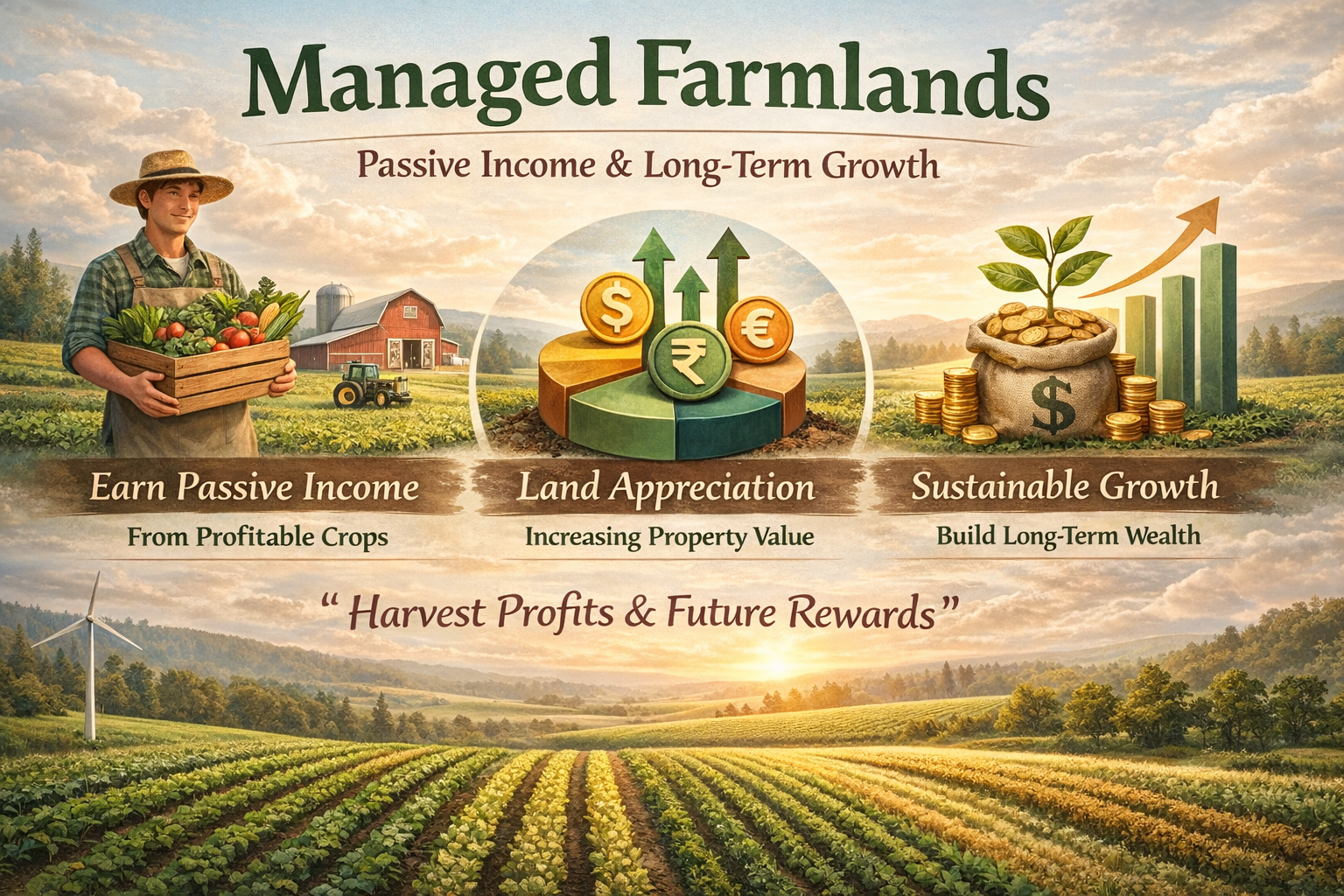
In today’s fast-paced world, busy professionals and NRIs are constantly searching for investments that generate income without demanding daily attention. While apartments and commercial spaces dominate urban portfolios, managed farmlands in Kurnool are quietly becoming a powerful alternative.
Why? Because they combine three powerful benefits:
✔ Passive income
✔ Land appreciation
✔ Low management effort
Unlike traditional agricultural land where owners must oversee operations, managed farmland projects take care of cultivation, maintenance, harvesting, and revenue distribution. This transforms agriculture into a hands-free investment opportunity.
Understanding the Concept of Managed Farmland
What Makes It “Managed”?
Managed agricultural projects provide:
- Professional farm management
- Crop planning & execution
- Irrigation systems
- On-ground supervision
- Regular reporting to investors
This allows investors to enjoy ownership benefits without the operational headache.
For professionals working in cities like Hyderabad or Bengaluru, this is a practical way to diversify into farmland investment in Kurnool without relocating.
How Passive Income Is Generated
Managed farmland creates income in three main ways:
- Crop Sales Revenue – Profits from commercial crops like mango, teak, or other high-value plantations.
- Lease Income – Some models lease land to professional farmers.
- Capital Appreciation – Agricultural land historically appreciates over long periods.
The result? A dual benefit of annual returns plus long-term land value growth.
Why Kurnool Is Emerging as a Farmland Investment Hub
Strategic Location Advantage:
Kurnool sits strategically along NH44, connecting major South Indian cities. Improved road connectivity boosts both accessibility and land value.
As urban expansion gradually spreads outward, agricultural zones near developing corridors often see price appreciation.
Infrastructure & Growth Potential:
Kurnool is witnessing:
- Road widening projects
- Increased residential developments
- Growing demand for open land
As real estate prices in metro cities soar, investors are shifting focus to emerging tier-2 cities like Kurnool.
Water Resources and Agricultural Viability:
Sustainable water access is crucial for farmland success. Parts of Kurnool district benefit from irrigation projects and borewell-supported agriculture, making it viable for long-term plantation models.
Passive Income Potential from Managed Farmlands
Lease Model
In this model, land is leased to experienced cultivators. Investors receive a fixed annual rental return. This is ideal for risk-averse investors.
Crop Revenue Sharing
Here, investors earn a share of profits from crop sales. High-value crops like teak or fruit plantations can generate attractive returns over time.
Long-Term Appreciation
Historically, land outperforms many volatile assets over a 10–15 year horizon. As Kurnool expands, agricultural land for sale in Kurnool may see steady appreciation.
Comparing Managed Farmland with Traditional Real Estate
|
Factor |
Managed Farmland |
Apartments |
|
Maintenance |
Handled by operator |
Owner responsibility |
|
Entry Cost |
Lower |
Higher |
|
Rental Yield |
Moderate |
Moderate |
|
Appreciation |
High (long-term) |
Depends on location |
|
Liquidity |
Medium |
Medium |
For investors looking to diversify beyond flats and duplex houses, farmland provides portfolio balance.
Risks, Returns & What Investors Should Check
Before investing, consider:
✔ Clear land title
✔ Water availability
✔ Crop selection strategy
✔ Developer credibility
✔ Exit options
Diversification is key. Avoid putting 100% capital into one agricultural project.
Who Should Invest in Managed Farmlands in Kurnool?
Managed farmlands in Kurnool are ideal for:
- Busy IT professionals
- NRIs seeking Indian land assets
- Investors looking for inflation hedge
- Long-term wealth builders
If your goal is steady growth rather than quick flipping, farmland aligns well with a 7–15 year horizon.
Conclusion: Managed Farmlands That Grow With You
Farmlands today are no longer viewed as just agricultural spaces—they have evolved into future-ready investment assets that blend sustainability, lifestyle benefits, and long-term financial growth.
With its strategic location in Kurnool, professionally managed plantations, thoughtfully planned gated farmland layouts, and a strong focus on eco-friendly living, Doctors Farm Lands by Anantha Projects represents a new generation of Managed farmland in kurnool investments.
This project offers more than just land ownership—it offers an opportunity to be part of a green, sustainable investment that grows alongside you. For investors seeking passive income, asset appreciation, and a connection with nature, managed farmlands like this present a compelling and future-proof choice.
As demand for sustainable land investments continues to rise, projects like these are shaping the next chapter of real estate in Kurnool.
Author
From the Desk of the Digital Research & Insights Wing, Anantha Projects — Kurnool & Hyderabad’s No.1 Property Developer, creating premium villas and modern gated communities that redefine luxury living in South India.
FAQs
1. Is buying farmland in Kurnool a good investment?
Yes, farmland in Kurnool is considered a promising long-term investment due to increasing land demand, improving infrastructure, and agricultural potential. Managed farmland projects make it easier for investors to generate passive income while benefiting from long-term land appreciation.
2.What are managed farmlands and how do they work?
Managed farmlands are agricultural properties where professional farm managers handle cultivation, irrigation, crop maintenance, and harvesting. Investors own the land while the management team operates the farm, allowing owners to earn income without actively farming.
3.How much does farmland cost in Kurnool?
The price of farmland in Kurnool varies depending on location, road access, water availability, and development status. Agricultural land near highways or gated farmland projects generally commands higher prices compared to remote rural areas.
4. What crops are commonly grown in Kurnool farmlands?
Common crops grown in Kurnool farmlands include mango, pomegranate, groundnut, cotton, and various seasonal crops. Some managed farmland projects also focus on plantation crops that provide long-term returns.
5.What should I check before investing in managed farmland?
Before investing, ensure that:
The land has a clear legal title
Water sources are available
The farmland project has professional management
There is proper road connectivity
Exit or resale options are available